
SAP ABAP Interview Questions & Answers for Beginners
Table of Contents
- • What is SAP ABAP?
- • Basic Interview Questions
- ↳ 1. What is a Transparent Table in SAP ABAP?
- ↳ 2. What is the difference between a Domain and a Data Element?
- ↳ 3. What is SE11 used for in SAP ABAP?
- ↳ 4. What is SE16N in SAP ABAP?
- ↳ 5. What are Internal Tables in SAP ABAP?
- ↳ 6. What is a Work Area in SAP ABAP?
- ↳ 7. What is SELECT in SAP ABAP and how is it different from SQL?
- ↳ 8. What is a BAPI in SAP ABAP?
- ↳ 9. What is an IDoc in SAP ABAP?
- ↳ 10. What is the difference between a Function Module and a Subroutine?
- ↳ 11. What is SE37 in SAP ABAP?
- ↳ 12. What is the difference between MOVE and MOVE-CORRESPONDING?
- ↳ 13. What is Debugging in SAP ABAP?
- ↳ 14. What is a Message Class in SAP ABAP?
- ↳ 15. What does the Z or Y prefix mean in SAP?
- • Quick Tips Before Your Interview
- • Self-Assessment Checkpoints
- • My Take on This Topic
If you are preparing for your first SAP ABAP job interview, I know exactly how you feel. When I was starting out, I had no idea what to expect. The questions seemed technical, and the answers in standard documentation were often unclear and difficult to digest.
In this guide, I am breaking down the most commonly asked SAP ABAP interview questions in a simple, practical way. I will use clear language and real-world comparisons so you can remember the concepts and explain them confidently to your interviewer.
Let’s get started.
What is SAP ABAP?
Before we look at the interview questions, let’s understand what SAP ABAP is at a high level.
SAP ABAP (Advanced Business Application Programming) is a fourth-generation programming language developed by SAP in the 1980s. It is used to create custom reports, interfaces, structures, forms, and business applications on top of the SAP NetWeaver application server. Almost everything you see in a standard SAP GUI interface is built using SAP ABAP. If you want to work as a technical SAP developer, consultant, or analyst, mastering ABAP is essential.
Basic Interview Questions
1. What is a Transparent Table in SAP ABAP?
A Transparent Table in the ABAP Dictionary is a database table that has a direct 1-to-1 relationship with the physical database. It exists in the database under the same name and contains the same fields and structure as defined in the SAP SE11 dictionary.
For example, if you create a custom transparent table called ZSTUDENTS in SAP, a matching table named ZSTUDENTS will be created automatically in the underlying database (such as Oracle, DB2, or SAP HANA). Transparent tables are used to store master and transaction data centrally (e.g., student IDs, names, sales orders).
2. What is the difference between a Domain and a Data Element?
This is one of the most popular interview questions for freshers, and many candidates get confused. Here is the best way to explain the difference:
- Domain (Technical Characteristics): Defines the technical attributes of a field, such as data type, character length, decimal places, and value range constraints (e.g., character data type of length 10).
- Data Element (Semantic Meaning): Describes the business meaning or role of a field. It provides user labels, short/long descriptions, and documentation (e.g., “Student ID” or “Customer Number”).
Domain vs. Data Element Comparison
| Feature | Domain | Data Element |
|---|---|---|
| Primary Role | Technical attributes (data type, length) | Semantic meaning (screen labels, documentation) |
| Reusable | Yes, referenced by multiple data elements | Yes, referenced by multiple table fields |
| Defines Value Lists | Yes, via the “Value Range” tab | No |
| Bound to Fields | No, fields reference data elements | Yes |
Visual Concept: A Domain defines how data is stored in the database. A Data Element defines what the field means on the user interface.
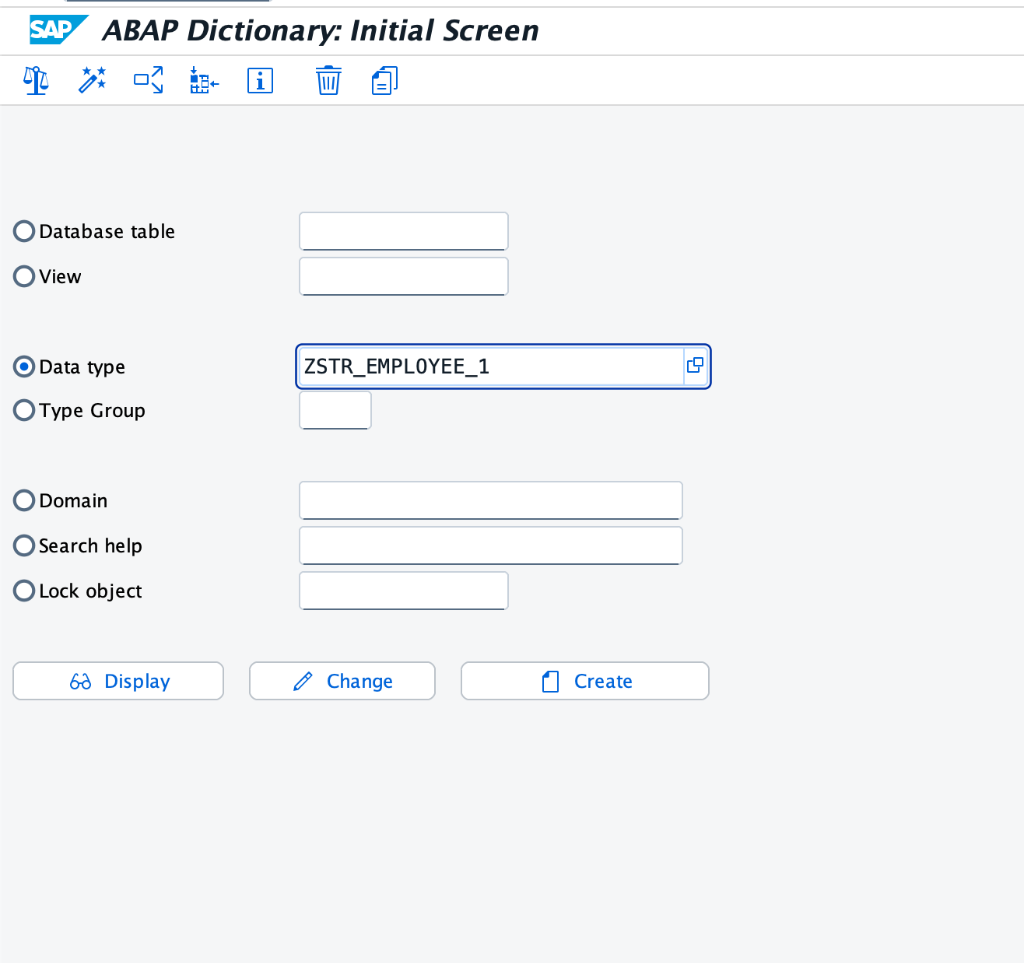
3. What is SE11 used for in SAP ABAP?
SE11 is the transaction code (T-code) for the ABAP Dictionary. It is the central workbench interface where developers create, design, edit, and manage data structures in SAP.
Inside SE11, you can manage the following database objects:
- Database Tables (Transparent, Pooled, and Cluster tables)
- Views (Database views, projection views, help views)
- Data Types (Data elements, structures, table types)
- Type Groups (Collections of global types)
- Search Helps (Dropdown F4 validation menus)
- Lock Objects (Concurrency controls to lock table records)
SE11 Dictionary Workbench Interface:
4. What is SE16N in SAP ABAP?
SE16N is a read-only transaction code used to browse database table data. It allows developers and functional consultants to inspect table contents, filter records, search for entries, and check if their ABAP programs are reading or writing data correctly.
(Unlike the older SE16 transaction, SE16N provides a modernized grid view with user-friendly search criteria filters).
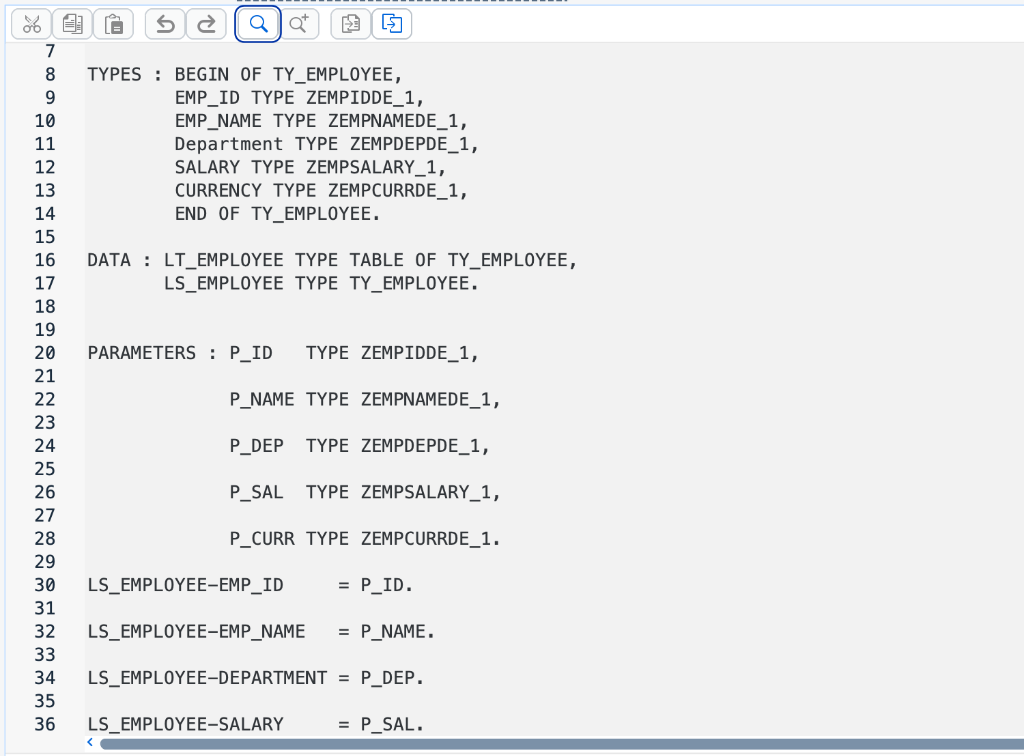
5. What are Internal Tables in SAP ABAP?
An Internal Table is a temporary, structured data object that exists only in the application server’s RAM while a program is executing. It behaves like an array or an in-memory spreadsheet, allowing you to fetch rows from the database and manipulate them in your program before displaying the results.
There are three types of internal tables:
- Standard Table: Key access is sequential (linear search). It is very fast for appending new lines at the end.
- Sorted Table: Records are automatically sorted in memory based on a defined key. Access is fast using binary search.
- Hashed Table: Accessed using a hash algorithm. It is highly optimized for very large datasets as access time remains constant regardless of size.
Internal Table & Work Area Declarations in ABAP Editor:
6. What is a Work Area in SAP ABAP?
A Work Area is a single-row structure in memory that matches the columns of an internal table. Since ABAP cannot process multiple rows of an internal table simultaneously, it reads records one row at a time. The system copies the current row into the Work Area, processes its fields, and then proceeds to the next line.
7. What is SELECT in SAP ABAP and how is it different from SQL?
SAP ABAP uses a subset of SQL called Open SQL. Open SQL allows you to write database queries that run on any database platform (Oracle, HANA, SQL Server) without changing your ABAP code. The ABAP database interface automatically translates Open SQL into native SQL for the specific database engine.
Unlike standard SQL, Open SQL utilizes ABAP-specific additions, such as writing results directly into internal tables:
" Open SQL Syntax in ABAP (fetching student records into an internal table)
SELECT student_id, name
  FROM zstudents
  INTO TABLE @gt_students.
8. What is a BAPI in SAP ABAP?
BAPI stands for Business Application Programming Interface. It is a standardized, RFC-enabled function module designed to allow external non-SAP systems (like web apps, mobile apps, or third-party databases) to interact securely with SAP business objects (e.g., creating a sales order, fetching vendor details).
9. What is an IDoc in SAP ABAP?
IDoc stands for Intermediate Document. It is a standard data container format used to exchange business data asynchronously between different SAP systems or between SAP and external legacy systems. For example, when a purchase order is created, an IDoc is generated and sent to a vendor’s shipping system.
10. What is the difference between a Function Module and a Subroutine?
Both are reusable blocks of code in ABAP, but they serve different roles:
- Subroutine (
FORM ... ENDFORM): Defined locally inside an ABAP program. It is typically called within the same program using thePERFORMstatement to break down long blocks of code into manageable pieces. - Function Module (
CALL FUNCTION): Defined globally using transaction SE37 inside the Function Builder. It belongs to a Function Group and can be called by any ABAP program across the system. It is also capable of running remotely (RFC) or via web APIs.
11. What is SE37 in SAP ABAP?
SE37 is the transaction code for the Function Builder. It is the developer workbench used to define, edit, code, test, and activate Function Modules. It is also where you configure importing, exporting, changing, and exception parameters for modular programs.
12. What is the difference between MOVE and MOVE-CORRESPONDING?
MOVE(or=): Copies the entire value of one variable or structure directly to another, assuming the structures are technically compatible.lv_num2 = lv_num1. " Direct copyMOVE-CORRESPONDING: Copies values between two structures by matching field names. Even if the column positions are different, fields with identical names are copied, while unmatched columns are ignored.MOVE-CORRESPONDING gs_sales_input TO gs_sales_output.
13. What is Debugging in SAP ABAP?
Debugging is the process of executing an ABAP program step-by-step in the SAP GUI Debugger to inspect variable values, check internal table records, track execution paths, and isolate programming bugs. You start the debugger by setting a breakpoint on a line of code or by entering /h in the command field before running the program.
14. What is a Message Class in SAP ABAP?
A Message Class is a central container configured via transaction SE91 that stores text messages (errors, warnings, notifications). Storing messages centrally allows them to be reused across different programs and translated into multiple languages easily.
In ABAP, messages are called using the MESSAGE keyword:
MESSAGE e001(zmy_msg_class).e: Defines the message type. Common types areE(Error),W(Warning),I(Information),S(Success), andA(Abort).001: The specific message number in the class.zmy_msg_class: The name of the message class.
15. What does the Z or Y prefix mean in SAP?
SAP reserves standard namespaces for its own product objects. Any object created by a customer developer (custom database tables, structures, programs, classes) must begin with the prefix Z or Y. This namespace isolation prevents custom developments from being overwritten during system upgrades and support package installations.
Quick Tips Before Your Interview
To perform well in your ABAP interview, keep these guidelines in mind:
- Know the Core T-codes: Be ready to list
SE11(Dictionary),SE16N(Data Browser),SE37(Function Builder),SE38(ABAP Editor), andSE80(Object Navigator). - Domain vs. Data Element: Practice explaining this concept. Interviewers use it to gauge your fundamental understanding of the SAP data model.
- Internal Table Types: Always remember standard, sorted, and hashed tables, along with their search performance differences.
- Be Honest: If you do not know the answer to a question, do not guess. Say: “I haven’t worked with that specific feature in my projects yet, but I understand the theory behind it.” Interviewers value honesty and logical thinking over memorized, incorrect answers.
Self-Assessment Checkpoints
💡 **What is the difference between SE11 and SE80?**
SE11 is dedicated solely to managing database dictionary objects. SE80 (Object Navigator) is a full Integrated Development Environment (IDE) that displays a folder structure of all objects in a package, including programs, classes, screens, dictionary structures, and function modules.
💡 **What is SY-SUBRC and what does a value of 0 mean?**
SY-SUBRC is a system variable that returns the return code of the last executed ABAP statement (such as database reads or searches). A value of 0 means the statement executed successfully (e.g., a query found a matching record). Any non-zero value (typically 4) indicates failure.
My Take on This Topic
For junior developers, SAP ABAP interviews focus heavily on the basics. You do not need years of configuration experience to crack your first interview; you just need a clear understanding of the fundamentals. If you can explain how data flows from a Domain to a Data Element, into a Transparent Table, and is finally processed using an Internal Table inside an ABAP program, you are well-prepared for your interview.
In future posts, I will cover more advanced topics, including ALV Reports, BDCs, Enhancements, User Exits, and Object-Oriented ABAP (OO-ABAP). Bookmark this guide, and happy learning!
— Daksh

Written by Daksh Dedha
SAP Technical ConsultantDaksh is an SAP Technical Consultant specializing in ABAP programming, SAP S/4HANA migrations, Fiori development, and BTP cloud architecture. He authors free, hands-on tutorials to make enterprise SAP education accessible to all developers.
Test Your Knowledge
Loading question...
Quiz Completed
Related Tutorials
SAP ABAP Enhancement Framework — User Exits, BADIs, and Enhancement Points
Master SAP ABAP enhancements. Learn User Exits, Customer Exits, BADIs, Enhancement Points, and Implicit/Explicit Enhancement Spots to modify standard SAP without modifying source code.
ABAP ProgrammingABAP CDS Views — Core Data Services Complete Guide for Beginners
Learn ABAP CDS Views from scratch. Understand how to create CDS views in Eclipse ADT, use annotations, associations, parameters, and build OData services with CDS.
ABAP ProgrammingMessage Handling in SAP ABAP — Complete SE91 Message Classes Guide
Master SAP ABAP message handling. Learn how to create message classes in transaction SE91, use the MESSAGE statement, handle error types A E W I S X, and pass placeholders.
Found this tutorial useful? Share it with your SAP development team.