
Opportunities in SAP for Freshers: Your Complete Roadmap to Getting Started
Table of Contents
- • Why Consider a Career in SAP?
- • Two Big Career Tracks in SAP
- ↳ 1. Functional Track
- ↳ 2. Technical Track
- • SAP Modules: Which One Is Right for You?
- ↳ SAP FICO (Finance and Controlling)
- ↳ SAP MM (Materials Management)
- ↳ SAP SD (Sales and Distribution)
- ↳ SAP HCM (Human Capital Management)
- ↳ SAP BASIS (System Administration)
- ↳ SAP ABAP (Technical Development)
- ↳ SAP S/4HANA and Fiori: The Modern Layer
- • What Kind of Jobs Can Freshers Get in SAP?
- • Realistic Salary Expectations for SAP Freshers in India
- • How to Get Started as a Fresher: Step-by-Step
- ↳ Step 1: Choose Your Module
- ↳ Step 2: Get Access to a Practice System
- ↳ Step 3: Consider Getting Certified
- ↳ Step 4: Build a Configuration Portfolio
- ↳ Step 5: Target Service Providers First
- ↳ Step 6: Build Your Presence on LinkedIn
- • Common Mistakes New SAP Learners Make
- • Self-Assessment Checkpoints
- • What Matters Most Here

So, you just heard about SAP. Someone told you there’s great career potential in it. Maybe it was a senior at college, a LinkedIn post, or maybe you stumbled across a job listing that said “SAP Fresher” with a salary that made your eyes go wide.
Either way, you are here now. I want to give you the most honest and practical breakdown of what SAP actually offers for someone who is just starting out.
No fluff. No generic talk. Just real information, module-wise breakdown, and a roadmap you can actually follow to kickstart your career.
Why Consider a Career in SAP?
Before picking a career path, it makes sense to understand why SAP is worth your time.
SAP is used by over 400,000 companies worldwide—from mid-sized enterprises to Fortune 500 giants like Coca-Cola, Nestlé, BMW, and Infosys. Every time a large company processes a purchase order, manages payroll, tracks inventory, or generates a financial report, there is a very high chance SAP software is running behind the scenes.
What this means for you as a fresher: demand is constant. Companies do not just implement SAP once and walk away. They need consultants, developers, and support professionals on a continuous basis. This creates a steady stream of job openings globally, and freshers are actively recruited for many of these roles.
Two Big Career Tracks in SAP
Before committing to a module, you need to understand that SAP careers broadly split into two distinct tracks:
1. Functional Track
Functional consultants understand business processes. You do not need to write code. Instead, you configure SAP settings based on a company’s business requirements—such as setting up payment terms, defining approval workflows, or mapping organizational structures.
- Best suited for: Commerce graduates, MBA students, business management backgrounds, finance, or HR graduates.
2. Technical Track
Technical consultants and developers write code, build reports, create interfaces, and handle database integrations. This track is developer-focused and revolves around ABAP (SAP’s proprietary programming language) or modern web-based technologies (SAP Fiori/UI5).
- Best suited for: B.Tech/B.E. graduates in Computer Science, IT, Electronics, or anyone with a programming background.
SAP Modules: Which One Is Right for You?
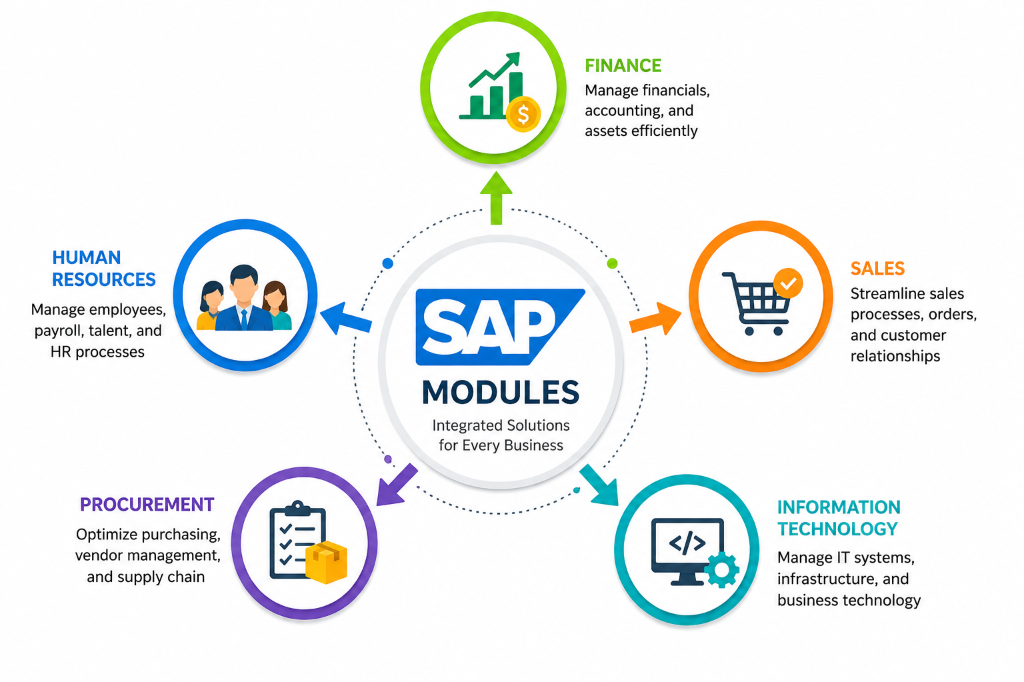
SAP is not a single tool. It is a collection of modules, each focused on a different business department. Choosing the right module based on your background makes your learning journey much smoother.
SAP FICO (Finance and Controlling)
- What it does: Manages all financial transactions, accounts payable, accounts receivable, general ledger, asset accounting, and cost center reporting.
- Who should pick this: Commerce graduates, CA/ICWA students, MBA Finance, or anyone with a solid understanding of accounting.
- Why it is great for freshers: FICO is one of the most in-demand modules. Every company running SAP needs a FICO team, resulting in a high volume of job postings.
SAP MM (Materials Management)
- What it does: Handles procurement cycles and inventory management—from raising a purchase requisition to issuing purchase orders, receiving goods, and verifying invoices.
- Who should pick this: Supply chain students, logistics graduates, or mechanical/industrial engineers.
- Why it is great for freshers: Manufacturing and retail companies are major SAP users, and MM is a core module in almost every implementation.
SAP SD (Sales and Distribution)
- What it does: Manages customer orders, pricing conditions, shipping logistics, billing, and product delivery.
- Who should pick this: Marketing, business administration, or commerce graduates who understand sales cycles.
- Why it is great for freshers: SD is tightly integrated with MM. SD consultants work closely with business sales teams, so strong communication skills are highly valued.
SAP HCM (Human Capital Management)
- What it does: Manages HR processes, employee master data, payroll, time tracking, recruitment, and organizational management.
- Who should pick this: HR graduates, MBA HR, or anyone interested in human resource management systems.
- Why it is great for freshers: Mid-to-large enterprises run departments on HCM, making it a collaborative, people-oriented career path.
SAP BASIS (System Administration)
- What it does: BASIS is the system administration layer. Basis consultants handle installations, updates, user access authorizations, performance tuning, and backup management.
- Who should pick this: IT graduates interested in system administration, networking, databases, or cloud infrastructure.
- Why it is great for freshers: Basis professionals are the backbone of any SAP system. The learning curve is steep, but it offers high job security.
SAP ABAP (Technical Development)
- What it does: ABAP developers write custom programs, reports, data interfaces (BAPIs, IDocs, RFCs), forms, and system enhancements.
- Who should pick this: Computer Science, IT, or engineering graduates who enjoy coding and database query optimization.

SAP S/4HANA and Fiori: The Modern Layer
S/4HANA is SAP’s next-generation cloud-ERP system, and Fiori is its modern web user interface. Companies worldwide are migrating their older systems to S/4HANA. Learning S/4HANA basics alongside your core module immediately differentiates your resume from candidates who only know legacy versions.
What Kind of Jobs Can Freshers Get in SAP?
These are the common entry-level roles you will find on job portals:
- SAP Trainee / Junior Consultant: Hired directly by IT services firms (TCS, Wipro, Infosys, Accenture, Capgemini). You go through structured bootcamps, shadow senior consultants, and work on live projects.
- SAP Support Analyst: Handles troubleshooting tickets. When business users face transaction issues, support analysts investigate and resolve them. This is a low-pressure entry point to learn live configurations.
- SAP Test Analyst: Validates whether configurations work correctly. Testing roles do not require deep programming knowledge and expose you to full business flows.
- SAP Data Migration Analyst: Manages data extraction, cleaning, and loading from legacy systems to SAP using tools like LSMW or BAPIs.
Realistic Salary Expectations for SAP Freshers in India
SAP skills command premium pay compared to general IT roles. Here are the average starting salaries:
- SAP Certified Fresher (Self-Trained): ₹3 LPA – ₹5 LPA
- SAP Trainee (Major IT Services Firms): ₹3.5 LPA – ₹6 LPA
- Fresher in Boutique Consulting Firms: ₹4 LPA – ₹7 LPA
- After 1-2 Years of Experience: ₹7 LPA – ₹12 LPA (growth accelerates once you have completed a live project)
With 5+ years of experience, a skilled SAP consultant in India routinely earns between ₹15 LPA to ₹30+ LPA, with opportunities for international onsite deployments.
How to Get Started as a Fresher: Step-by-Step
Follow this structured roadmap to land your first SAP role:

Step 1: Choose Your Module
Do not try to learn everything at once. Focus on one module that aligns with your educational background (e.g., FICO for finance, ABAP for coding).
Step 2: Get Access to a Practice System
You cannot learn SAP just by watching video tutorials; you must practice. Get access to an IDES sandbox or the official SAP Learning Hub to run transactions yourself.
Step 3: Consider Getting Certified
While not always mandatory, obtaining an official certification (like the SAP Certified Application Associate) validates your skills and makes your resume stand out when you lack professional work experience.
Step 4: Build a Configuration Portfolio
Document your learning. Take screenshots of configurations you complete in the system (e.g., creating a company code, writing a loop), write down the T-codes, and save them in a portfolio to share with interviewers.
Step 5: Target Service Providers First
Apply to SAP implementation partners and service providers rather than end-user companies. Service firms have larger teams and are more willing to train junior resources.
Step 6: Build Your Presence on LinkedIn
Share your learning journey. Post daily updates about configuration steps, standard T-codes you practiced, or challenges you solved. Recruiters look for proactive candidates sharing SAP content.
Common Mistakes New SAP Learners Make
Avoid these common pitfalls when starting out:

- Learning Multiple Modules Simultaneously: Focus on mastering one module. A deep understanding of FICO is far more valuable than a surface-level glance at three different modules.
- Watching Videos Without Practicing: SAP is a hands-on system. If you are not logging in and running T-codes, you are not building real skills.
- Ignoring Integration Points: No SAP module operates in isolation. Learn how your module connects with others (e.g., MM procurement posting to FICO accounts).
- Expecting Immediate Six-Figure Salaries: Realize that starting salaries are modest, but pay scales grow exponentially once you gain live project experience.
- Neglecting Soft Skills: SAP consultants spend a lot of time speaking with business managers. Your communication and presentation skills are just as important as your technical configurations.
Self-Assessment Checkpoints
💡 **Should I choose a functional module or a technical module?**
Choose based on your interest and degree. If you enjoy coding, databases, and logic design, choose a technical track like SAP ABAP. If you prefer business operations, accounting, HR, or sales cycles, choose a functional track like FICO, MM, or SD.
💡 **Is SAP training expensive? How can I learn on a budget?**
While classroom courses can be expensive, you can learn fundamentals on a budget using platforms like openSAP, Udemy, YouTube, and the official SAP Learning Journey documentation. The key investment is getting system access to practice.
What Matters Most Here
Entering the SAP ecosystem takes patience and hands-on practice, but the career returns are exceptional. By choosing one module, practicing consistently on a system, and sharing your progress, you can successfully land your first SAP job within 6 to 12 months.
Take the first step this week: pick a module, watch a couple of overview videos, and map out your schedule.
— Daksh

Written by Daksh Dedha
SAP Technical ConsultantDaksh is an SAP Technical Consultant specializing in ABAP programming, SAP S/4HANA migrations, Fiori development, and BTP cloud architecture. He authors free, hands-on tutorials to make enterprise SAP education accessible to all developers.
Test Your Knowledge
Loading question...
Quiz Completed
Related Tutorials
Is SAP ABAP a Good Career in 2026? Honest Answer from an Insider
Is SAP ABAP a good career in 2026? Get an experience-backed honest answer covering the job market, salaries, S/4HANA migration demand, future scope
SAP FundamentalsWhat is SAP? The Ultimate Enterprise Guide to SAP ERP, Architecture & Modules
A technical and beginner-friendly deep dive into what SAP is, how Enterprise Resource Planning (ERP) works, its 3-tier and S/4HANA architecture, core modules, real-world business workflows, and career paths.
SAP FinanceSAP Accounting Software: The Ultimate Guide to SAP S/4HANA Finance & FICO
Discover how SAP accounting software powers global enterprise finance. Explore SAP FICO modules, Universal Journal (ACDOCA), S/4HANA Finance migration, and real-time ledger accounting.
Found this tutorial useful? Share it with your SAP development team.