
Is SAP ABAP a Good Career in 2026? Honest Answer from an Insider
Table of Contents
- • Why This Question Comes Up Frequently
- • What’s Actually Happening in the SAP World Now
- • The Job Market Reality in 2026
- • SAP ABAP Salary in India 2026: Real Figures
- ↳ For Onsite Roles:
- • How SAP ABAP in 2026 Compares to Five Years Ago
- ↳ 1. SAP ABAP Cloud and the Steampunk Environment
- ↳ 2. RAP: RESTful SAP ABAP Programming Model
- ↳ 3. SAP ABAP on HANA
- ↳ 4. Clean ABAP
- • SAP ABAP vs. Web Development & Python: Honest Comparison
- • Who is ABAP Best Suited For in 2026?
- • The Challenges You Should Know About
- • What Makes an Exceptional ABAP Developer in 2026?
- • Where to Go From Here
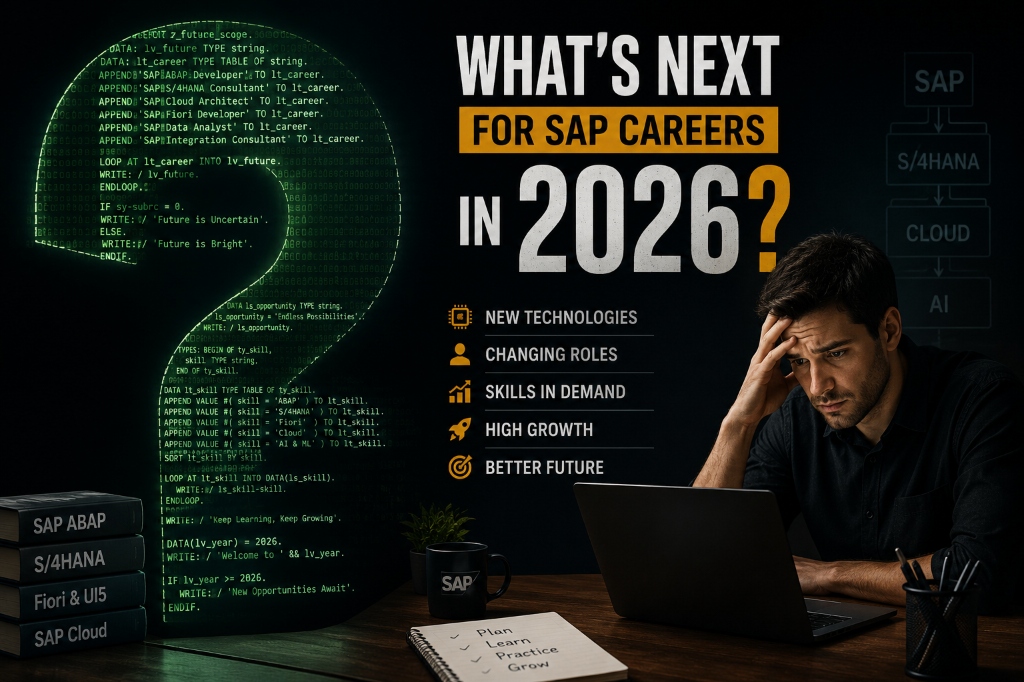
Let me start with something that might surprise you. Every month, someone posts on LinkedIn or a developer forum asking: “Is ABAP dead?” or “Should I still learn SAP ABAP in 2026?”
And every single time, that post floods with comments from two completely opposite camps:
- The Enthusiasts: “Yes! Massive demand, great salaries, go for it!”
- The Doomsayers: “It is a legacy technology, cloud is replacing everything, don’t waste your time.”
Both groups are partially right. And that’s exactly why nobody walking away from those comment sections ever feels truly informed. Neither camp is giving you the full picture; they’re just giving you their small slice of it.
This post is here to give you the complete picture. No motivational speeches about how ABAP will make you rich overnight, and no doomsday talk about the cloud wiping out every developer job. Just a grounded, field-level, honest breakdown of where SAP ABAP stands in 2026, so you can make a real decision for your career.
Grab a coffee. Let’s go through this properly.
Why This Question Comes Up Frequently
Before answering whether ABAP is a good career, it’s worth understanding why people keep asking this question. Three things fuel this confusion:
- First, SAP ABAP is old. It has been around since 1983. In a world where new JS frameworks and programming languages appear every year, anything 40 years old naturally raises eyebrows.
- Second, SAP is evolving. SAP itself keeps announcing cloud-first strategies, low-code tools, and AI integration. Freshers reading these announcements often assume traditional ABAP must be on its way out.
- Third, unfair comparisons. Most people compare SAP ABAP to general-purpose languages like Python, React, or Rust. Those comparisons look unfavorable on the surface because standard popularity metrics favor general-purpose web technologies.
None of these concerns are entirely wrong, but they don’t tell the complete story. The reality is that SAP ABAP is still heavily in demand, but the type of ABAP you need to write has changed.
What’s Actually Happening in the SAP World Now
SAP has over 400,000 customers across 180 countries. These aren’t small businesses; these are massive enterprises—manufacturers, pharma giants, retail conglomerates, government bodies, oil and gas corporations, and banks. For these companies, SAP is the operational backbone.
Currently, every single one of those companies running legacy SAP ECC systems is planning, executing, or completing a migration to S/4HANA (SAP’s next-generation ERP). SAP officially announced the end of mainstream maintenance for ECC by 2027, with extended support running through 2030.
This deadline has created one of the largest and most sustained migration waves in enterprise software history. Thousands of companies globally are mid-migration, and every migration requires skilled SAP ABAP developers.
Developers are needed to:
- Assess and refactor legacy custom code before migration.
- Identify which classic ABAP techniques are deprecated in S/4HANA and replace them.
- Rewrite reports and data models into modern, CDS-based equivalents.
- Restructure integration interfaces for the new database architecture.
This migration wave isn’t a one-year sprint. Large enterprise migrations typically run 3 to 7 years from planning to go-live. Companies that kicked off migrations in 2022 or 2023 are still deep in execution in 2026, and companies that haven’t started yet are scrambling to find resources.
SAP ABAP is in the middle of one of its most active demand periods, driven by the largest platform transition in SAP’s history.
The Job Market Reality in 2026
Let’s talk numbers because opinions without data are just noise. If you search for “SAP ABAP” on job portals like Naukri.com, you will find thousands of active listings across experience levels.
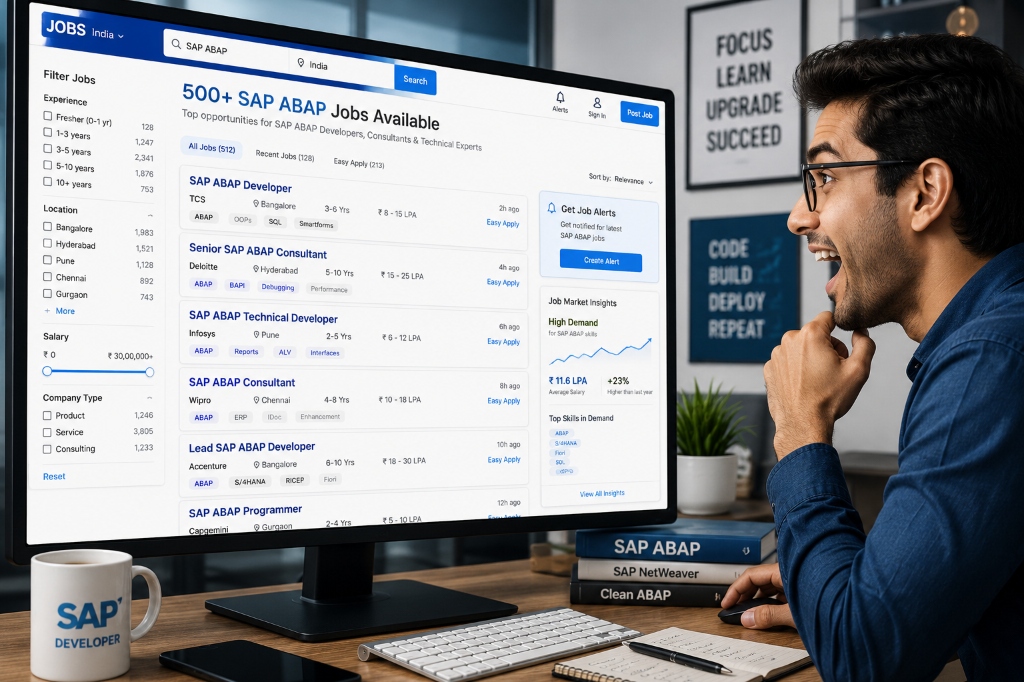
Companies actively hiring SAP ABAP developers include:
- Global IT Service Companies: TCS, Infosys, Wipro, HCL, Tech Mahindra, LTIMindtree, and Hexaware. All maintain large SAP practices and hire continuously.
- Big Consulting Firms: Accenture, Deloitte, IBM, Capgemini, EY, and PwC, who run large-scale S/4HANA transformation projects for global clients.
- SAP-Specific Partners: Boutique consultancies like Birlasoft, Kellton Tech, and Yash Technologies.
- End-User Companies: Manufacturers, retail brands, and pharma companies that run SAP internally and need in-house support teams.
Beyond India, regions like the Middle East (driven by Saudi Arabia’s Vision 2030 and UAE transformation programs), Europe (Germany, Netherlands, UK), and Australia show consistent demand for SAP ABAP professionals.
SAP ABAP Salary in India 2026: Real Figures
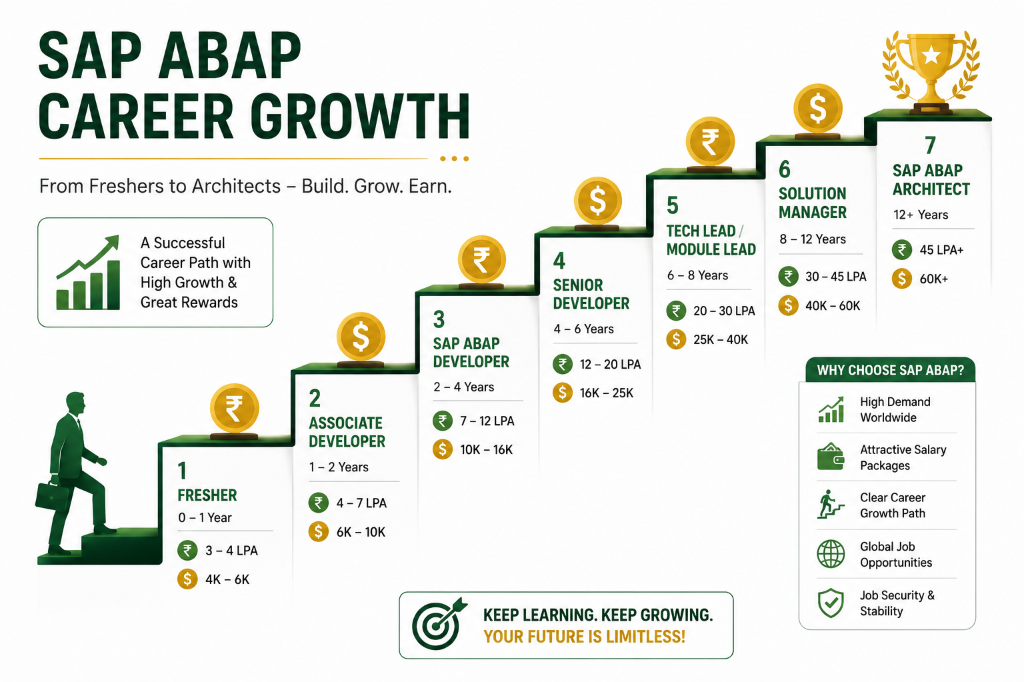
This is what most people want to know, so let’s be direct about the compensation ranges:
| Experience Level | Role / Designation | Approximate CTC (India) |
|---|---|---|
| 0 – 1 year | Fresher / Trainee | ₹3.5 LPA – ₹6.0 LPA |
| 1 – 3 years | Junior SAP ABAP Developer | ₹6.0 LPA – ₹12.0 LPA |
| 3 – 6 years | SAP ABAP Developer / Consultant | ₹12.0 LPA – ₹22.0 LPA |
| 6 – 10 years | Senior Consultant / Tech Lead | ₹22.0 LPA – ₹40.0 LPA |
| 10+ years | Solution Architect / Principal Consultant | ₹40.0 LPA – ₹80.0+ LPA |
For Onsite Roles:
- Middle East Contracts: $4,000 – $8,000 USD per month tax-free (depending on role and location).
- Europe (Germany, Netherlands): €70,000 – €130,000 annually.
- USA and Canada: $90,000 – $150,000+ annually for senior architects.
Why do these numbers hold up? Because SAP ABAP is highly specialized. Unlike Python or Java where millions of developers compete, experienced SAP ABAP professionals—especially those with S/4HANA, RAP, and ABAP on HANA knowledge—are genuinely scarce relative to market demand.
How SAP ABAP in 2026 Compares to Five Years Ago
This is a point that most “is ABAP relevant” discussions miss. The skillset of a developer who learns ABAP from scratch today is completely different from a decade ago.
Here is what modern SAP ABAP looks like in 2026:
1. SAP ABAP Cloud and the Steampunk Environment
SAP ABAP Cloud lets developers write code without the traditional on-premise SAP GUI. Development happens in Eclipse-based ADT (SAP ABAP Development Tools), a modern IDE with Git integration, code refactoring, syntax checking, and unit test runners.
2. RAP: RESTful SAP ABAP Programming Model
RAP is SAP’s modern framework for building transactional business applications in S/4HANA. Using RAP, ABAP developers build:
- CDS (Core Data Services) Views: Virtual data models replacing complex backend SQL joins.
- Behavior Definitions: Setting up transactional business actions.
- OData Services: APIs that power Fiori web applications and external integrations.
A developer building a RAP application in 2026 is basically doing backend API development for enterprise web applications.
3. SAP ABAP on HANA
SAP HANA is an in-memory database. ABAP on HANA means writing code that pushes intensive logic down into the database layer (Code Pushdown) using CDS views and AMDP (ABAP Managed Database Procedures).
4. Clean ABAP
Following the official “Clean ABAP” style guides, modern developers write modular, testable code using ABAP Unit tests, moving away from legacy spaghettis.
SAP ABAP vs. Web Development & Python: Honest Comparison
If you are choosing between general-purpose programming and SAP ABAP, here is a realistic comparison:
| Criteria | Python / Web Development | SAP ABAP |
|---|---|---|
| Market Saturation | Very high at entry levels. Millions of web developers compete. | Lower saturation. Specialized skills create a smaller talent pool. |
| Career Entry | Harder for freshers to stand out without exceptional portfolios. | Structured hiring via IT service providers and consultancies. |
| Work Environment | Fast-paced startups, product-based companies. | Large enterprises, consulting firms, structured processes. |
| Salary Growth | Scales high for top-tier engineers, but mid-level salaries can commoditize. | High and highly consistent salary progression as you gain years of experience. |
| Freelance Market | Large freelance market, but high competition and lower rates for beginners. | Smaller freelance market, but highly lucrative contract roles for seniors. |
The choice comes down to your personality and goals:
- If you want a fast-paced environment building consumer-facing apps or working in early-stage startups, go for Web Development or Python.
- If you prefer working with large enterprise clients, structured corporate processes, and want a stable, high-paying career with global mobility, go for SAP ABAP.
Who is ABAP Best Suited For in 2026?
Choosing ABAP is an excellent decision if:
- You want stability: You are a new graduate looking for structured learning, clear career progression, and stable growth without startup volatility.
- You want to work abroad: SAP skills are standardized globally. An ABAP certificate/experience from India is valued equally in Germany, the UAE, or Australia.
- You have functional SAP experience: If you already understand business processes (FICO, MM, SD), adding ABAP makes you an incredibly valuable hybrid “functional-technical” consultant.
- You are targeting European markets: Germany is SAP’s home base. Combining ABAP skills with German language skills is a golden ticket for European tech careers.
The Challenges You Should Know About
To be completely honest, here are the difficult aspects of starting an ABAP career:
- High barrier to entry: You cannot just install SAP on your laptop for free in 5 minutes like Python. You need system access, which usually requires paying for server access or joining a company that provides it.
- Steep learning curve at first: The first three months can feel dry and abstract because you are working with database layers and business logic rather than visual UI screens.
- Hiring takes time: Getting your very first fresher job can take 6–12 months of persistent networking and applying to service providers.
What Makes an Exceptional ABAP Developer in 2026?
If you want to command the highest salaries, you cannot just learn legacy syntax. You must master the full modern stack:
- Classic ABAP: Reports, ALV, BAPIs, IDocs, enhancements, and BADIs (still needed for support).
- S/4HANA & Cloud: CDS views, OData services, RAP framework, and Fiori integrations.
- ABAP on HANA: Code pushdown principles and AMDP.
- Testing & Quality: Object-Oriented ABAP, Design Patterns, and ABAP Unit testing.
- Soft Skills: The ability to speak both business and technical languages to gather requirements from business users.
Where to Go From Here
Is SAP ABAP a good career in 2026? Yes, it is.
We are in the middle of a massive global migration to S/4HANA. Modern ABAP is a highly capable, modern programming language powered by cloud environments. The career path offers strong financial growth, stability, and outstanding global mobility.
It requires patience to land your first role, but once you are in, the career rewards are highly consistent.
Start small, learn one concept daily, practice on SAP sandbox servers, and build your portfolio.
Keep learning, keep building!
— Daksh
learnsapfree.com

Written by Daksh Dedha
SAP Technical ConsultantDaksh is an SAP Technical Consultant specializing in ABAP programming, SAP S/4HANA migrations, Fiori development, and BTP cloud architecture. He authors free, hands-on tutorials to make enterprise SAP education accessible to all developers.
Test Your Knowledge
Loading question...
Quiz Completed
Related Tutorials
Opportunities in SAP for Freshers: Your Complete Roadmap to Getting Started
Discover career opportunities in SAP for freshers. Read our step-by-step roadmap to master functional and technical tracks, choose the right module
SAP FundamentalsWhat is SAP? The Ultimate Enterprise Guide to SAP ERP, Architecture & Modules
A technical and beginner-friendly deep dive into what SAP is, how Enterprise Resource Planning (ERP) works, its 3-tier and S/4HANA architecture, core modules, real-world business workflows, and career paths.
SAP FinanceSAP Accounting Software: The Ultimate Guide to SAP S/4HANA Finance & FICO
Discover how SAP accounting software powers global enterprise finance. Explore SAP FICO modules, Universal Journal (ACDOCA), S/4HANA Finance migration, and real-time ledger accounting.
Found this tutorial useful? Share it with your SAP development team.